|
Welcome to the Fifth Edition
|
| |
|
of the Task 53 Newsletter !
|
| |
|
Stay tuned for the latest updates on our mission to achieve interoperability in bidirectional charging worldwide! |
| |
|
This is the fifth Task 53 newsletter! (If you have missed the content of the previous ones, check out our archive).
Our newsletter is scheduled for every two months. You will receive Nr. 6 by the end of September.
Plug into the pulse of progress with the July Newsletter Edition from Task 53. This update will inform you about the following topics:
- New Partners, New Countries Welcome
- News from North America
- Update Timeline Task 53
- Past Events in Europe
- V2G Leaders Summit
- Become a Task 53 Partner
|
| |
|
New Partners, New Countries |
| |
|
We are very pleased to welcome the following new industrial partners, laboratories and non profit organizations since our last newsletter in May: |
| |
|
By clicking on the members logo you can visit their website. |
| |
|
We are very happy to announce the following new countries that joined forces with Task 53. If your company or institution is located in one of these countries, you have a reduced participation fee. Please contact us for further information. |
| |
|
If you want to see the list of all partners, please visit our website task53.org. |
| |
North America V2G - The Needle is moving |
| |
|
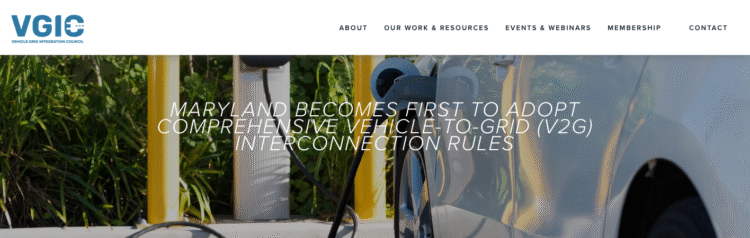
Maryland Public Service Commission is now leading the nation on V2G
Maryland becomes first state to adopt comprehensive V2G interconnection rules. The Maryland Public Service Commission (PSC) has unanimously voted to adopt a comprehensive suite of vehicle-to-grid (V2G) interconnection rules for both DC and AC systems, becoming the first US state to do so.
The rules were set by the Vehicle-Grid Integration Council (VGIC) in the US, an advocacy group committed to advancing the role of EVs and smart EV charging.
Updated in the Code of Maryland Regulations (COMAR) 20.50, the guidelines – which cover both AC and DC systems – now include the following key provisions:
- All V2G DC systems are subject to the existing rules for stationary energy storage. (Consistent with other states)
- All V2G AC systems can seek interconnection with the utility under one of two pathways
Option 1: Charger certified to UL 1741 SC and paired with a vehicle designed to the SAE J3072 standard.
Option 2: Charger and vehicle certified to UL 1741 SB as a composite Distributed Energy Resources (DER) system.
- Defines a V2G System. Not including the terms "V2G-Capable EV)" or "(EVSE)".
- Applies Appropriate Treatment to Backup-Only Systems.
Systems used in BIDIR only when islanded from the grid (e.g., for backup power) are not subject to a lengthy interconnection study process. Instead, customers using systems in this manner need to notify the utility of the existence and location of these backup power systems.
Similarly, bidirectional charging systems may be installed and operated in load-only mode until a customer wishes to enable grid-parallel bidirectional charging operation, at which point the customer must first request utility interconnection. This allows customers to install and use future-proofed charging stations even before a V2G program or rate is established.
Maryland's new V2G interconnection rules will officially go into effect on July 7, 2025.
Task 53 would like to thank our friends from VGIC for being a main driver in making this happen.
Source: UtilityDive |
| |
|
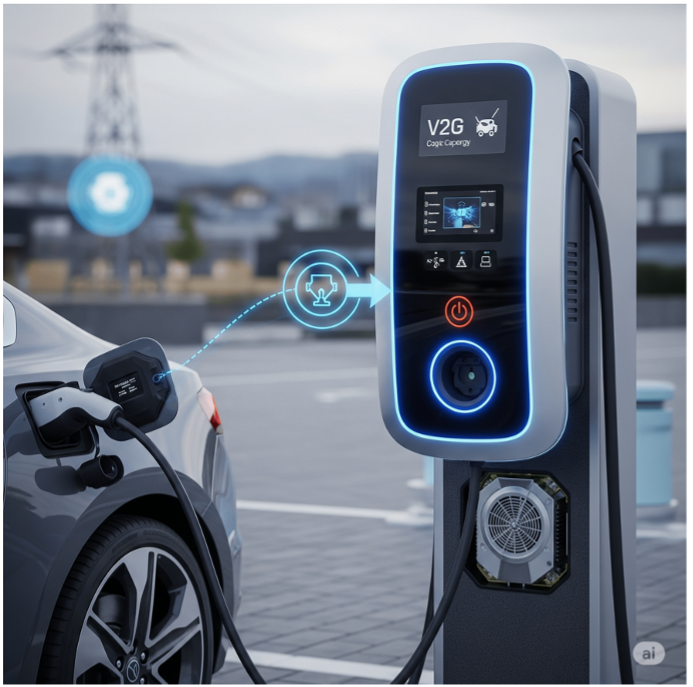
(Image: BillPierce.net, generted by Google Gemini) |
| |
Massachusetts to deploy 100 bidirectional EV chargers in first-of-its-kind "V2X Pilot" |
| |
|
Massachusetts is launching a statewide Vehicle-to-Everything (V2X) pilot program to test bidirectional EV charging. The two-year initiative will deploy 100 bidirectional chargers across various locations like homes, schools, and commercial fleets. This program, managed by Resource Innovations and The Mobility House, aims to enhance grid resilience, reduce energy costs, and integrate more renewable energy sources, while also providing backup power for participants.
- The Massachusetts Clean Energy Center will deploy 100 bidirectional electric vehicle chargers at no cost to residential, commercial, municipal and school customers as part of a two-year "vehicle-to-everything" demonstration, program partners Resource Innovations and The Mobility House said Feb. 24.
- The demonstration will add an estimated 1.5 MW of distributed energy storage capacity across Massachusetts by September 2026, when MassCEC expects all installations to be completed, Resource Innovations and TMH said.
- Calling the demonstration "a crucial step in Massachusetts's efforts to enable wide-scale adoption of electric vehicles," MassCEC Senior Director of Clean Transportation Rachel Ackerman said in a statement that the multi-sector deployment would help identify and resolve barriers to "accelerated application of V2X technology."
Source: Smart Energy International |
| |
California Energy Commission – Allocates up to $4 M for The ChargeYard Project |
| |
|
Purpose of Solicitation
The California Energy Commission’s (CEC’s) Clean Transportation Program announces the availability of up to $4 million in grant funds for projects that will provide an open and neutral space for industry collaboration, knowledge sharing, interoperability testing, and conformance testing for electric vehicle charging equipment. It is a competitive grant solicitation.
Below the timeline for the initiative. |
| |
| Activity |
Action Date |
| Solicitation Release |
14 March 2025 |
| Pre-Application Workshop 9:00-11:00 a.m. |
4 April 2025 |
| Deadline for Written Questions by 5:00 p.m. |
18 April 2025 |
| Anticipated Distribution of Questions/Answers |
4th week of May |
| Support for Application Submission in the Energy Commission Agreement Management System (ECAMS) until 5:00 p.m. |
Ongoing until June 2025 |
| Deadline to Submit Applications by 11:59 p.m. |
30 June 2025 |
| Anticipated Notice of Proposed Awards Posting |
September 2025 |
| Anticipated CEC Business Meeting |
October 2025 |
| Agreement Term End |
January 2031 |
|
| |
|
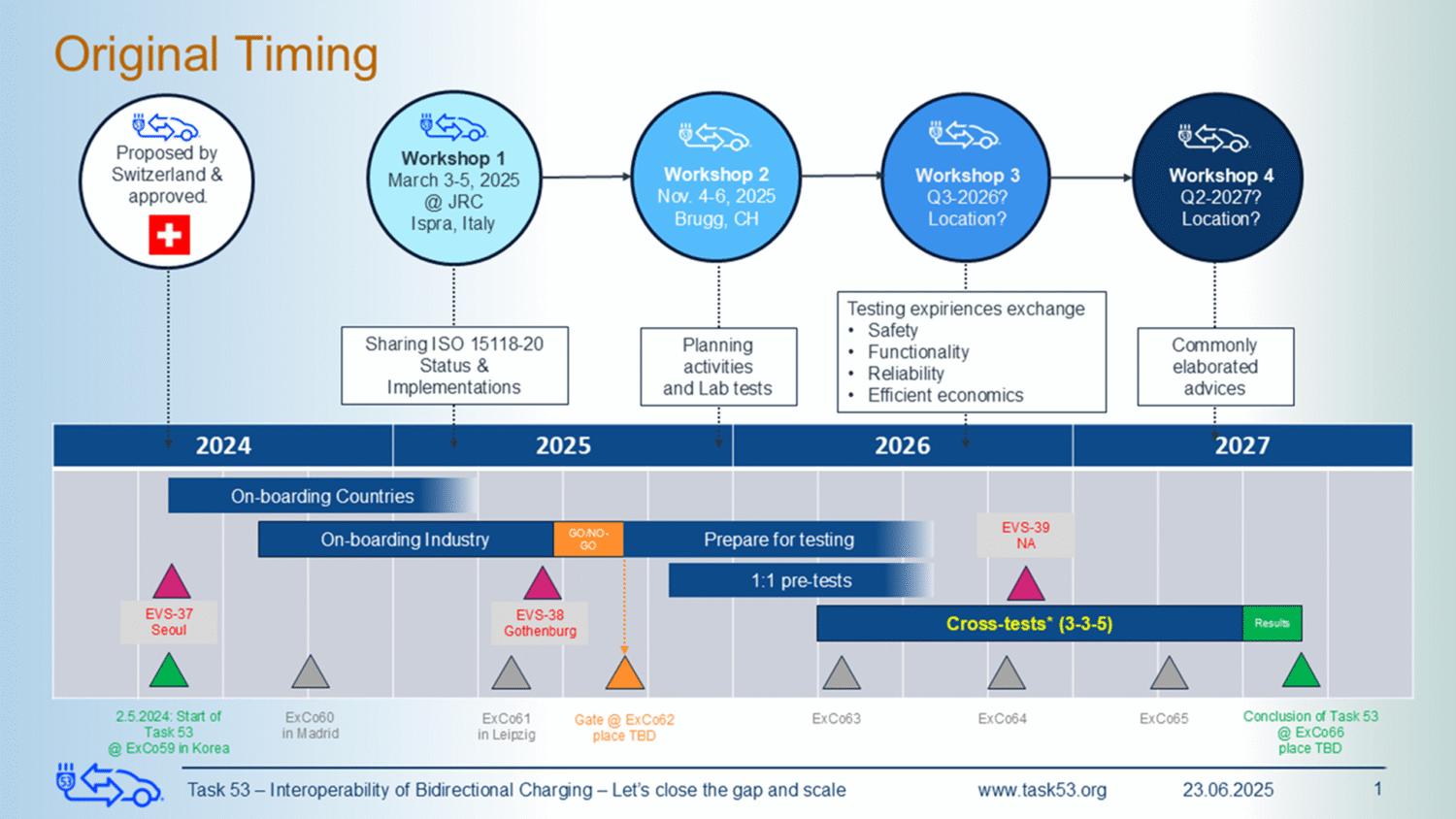
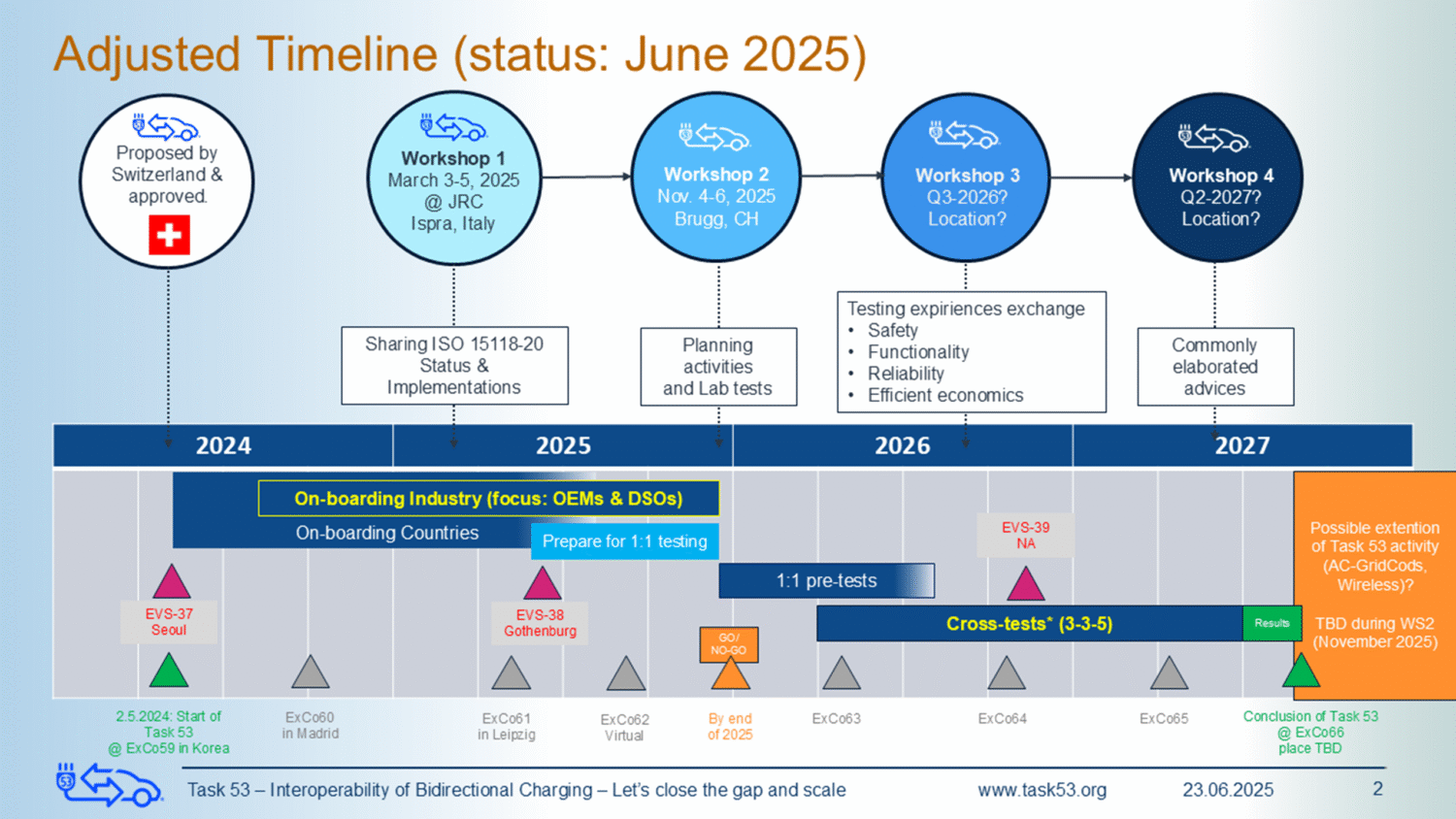
When Task 53 was launched in 2024, the expectation was to onboard a sufficient number of laboratories, countries, and industrial partners within the first year to enable the start of testing activities by the end of 2025.
So far, we are pleased to report that participation from countries has exceeded expectations, and coordination with laboratories – both in the EU and internationally – is progressing very well. We have also seen strong engagement from EVSE manufacturers, not only for AC and DC charging but increasingly also for wireless solutions.
In contrast, while discussions with DSOs and OEMs have been numerous and constructive, their formal onboarding has been slower than anticipated. For this reason, Task 53 decided to shift the internal GO/NO-GO decision from June to November 2025. This timing aligns with our second workshop in Brugg and the inaugural V2G Leaders’ Summit in Brussels, supported by the European Commission and organized in partnership with LHI.
In November, we will also initiate a consultation on the potential need to extend the duration of Task 53 beyond 2027. This may become necessary due to recent delays in the implementation of the European Grid Code regulations (notably EU 2016/631 R.2.0), which are particularly relevant for AC bidirectional charging. Additionally, a project extension could allow us to better accommodate and integrate the growing interest in wireless bidirectional charging, if confirmed.
Task 53 remains committed to its mission and is confident that this revised timeline will allow for more inclusive, robust, and harmonized progress across all stakeholder groups.
|
| |
- Interoperability is Key for Scaling V2G
There was a strong and consistent message across the board: to scale Vehicle-to-Grid (V2G) effectively, interoperability is essential. Collaboration and standardization are critical across all players – OEMs, charging infrastructure providers, grid operators, and software platforms.
- OEMs Are Slow Movers, But Change is Underway
Original Equipment Manufacturers (OEMs) are often compared to "big tankers" – they need time to steer, make decisions, and implement changes. However, all OEMs, including truck manufacturers, are clearly moving toward integrating bidirectional charging capabilities into their vehicles.
- AC vs. DC Bidirectional Charging
The debate about whether bidirectional charging will come via AC or DC is being reframed. For large vehicles like trucks and buses, DC is the only viable option due to size, cooling, charging power, and total cost of ownership.
In contrast, most passenger vehicles are exploring onboard AC bidirectional charging. But: once AC bidirectional functionality is onboard, there is little reason not to also enable a DC bidirectional interface. A great example: Volvo Cars is the first manufacturer to implement both AC and DC bidirectional charging in parallel (different markets will get one or the other solution), starting with their EX90 model.
Next EVS: EVS-39 in Long Beach, California: evs39.com (2026, 21-24 June) |
| |
|
V2G Leaders Summit 2025 - Join the Dialogue |
| |
|
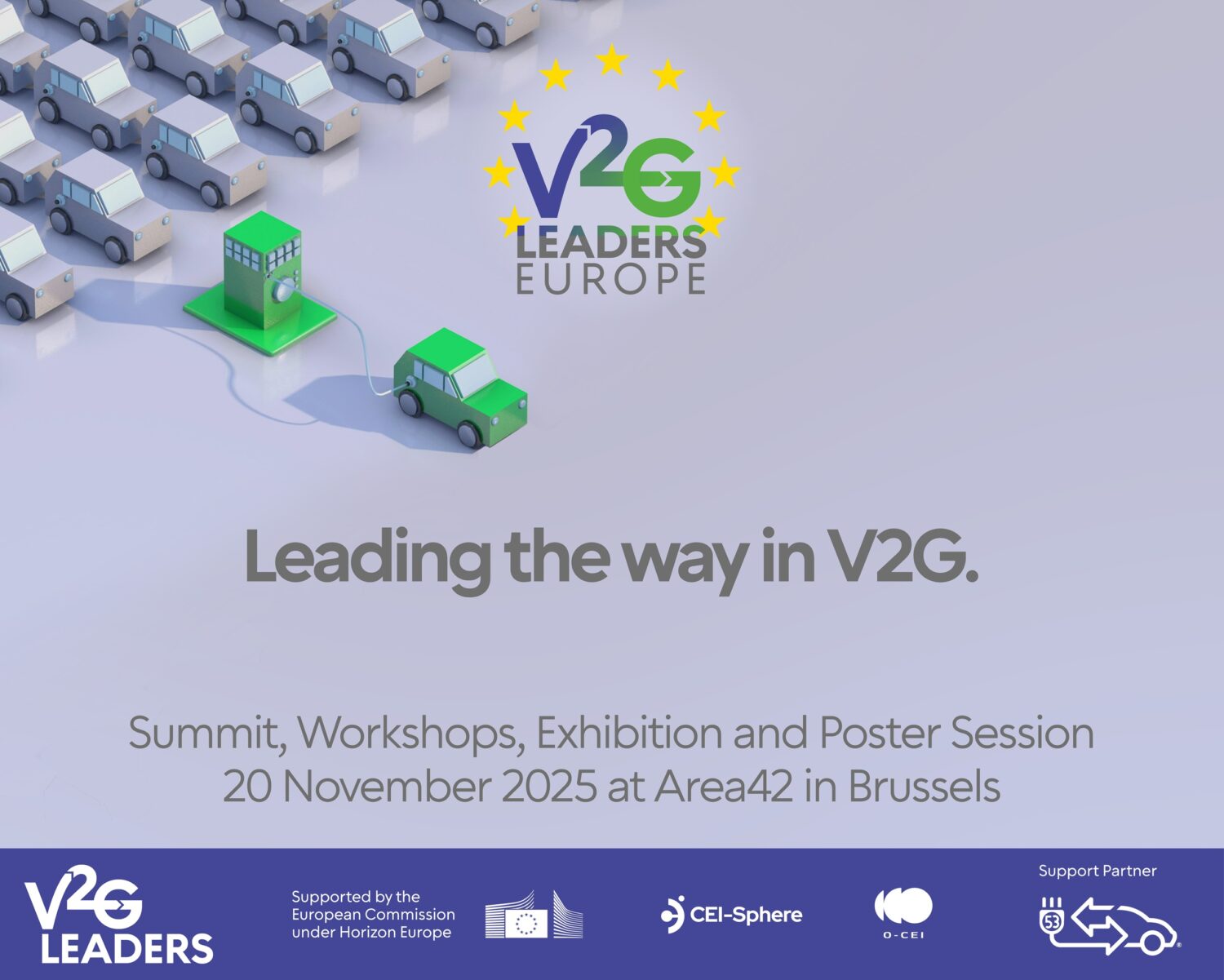
On November 20, Brussels hosts the inaugural V2G Leaders Summit: a high-level platform supported by the EU Commission to accelerate Vehicle-to-Grid innovation. Join policymakers, industry leaders, and Task 53 peers in shaping the future of energy and mobility.
As a partner, you’ll help shape strategic conversations, showcase your leadership, and connect with key EU decision-makers and innovators.
Secure your place: Annabell Schlensog | LHI AG |
| |
|
Become a Task 53 Partner and Shape the Future of Interoperability of Bidirectional Charging |
| |
|
As a Task 53 partner, you have full admission free of charge to our next workshop in Brugg as well as to the 3 Task 53 working groups and all their results. Be where the future of Interoperability of Bidirectional Charging will be shaped:
Date: November 4th to 6th 2025
Location: FHNW in Brugg-Windisch (30 min from Zürich, Switzerland) |
| |
|
If you have any comment, critique, suggestion, question referring to this Newsletter and/or Task 53: Please let us know.
Thank you for your continued support and participation in Task 53. Together, we are contributing to a more sustainable and interconnected future for electric vehicles and the energy systems.
|
| |
|
task53.org
You receive this newsletter because we contacted you in the past concerning task 53 or because you have registered for the gaps&bugs enquiry on our website task53.org. Please unsubscribe if you no longer wish to receive this newsletter. |
| |
|