|
Refining the 3:3:5 Framework
Partners aligned on the practical execution of the testing matrix, where multiple EV manufacturers, AC and DC EVSE suppliers, and DSOs evaluate concurrent interactions across communication and power layers.
The 3:3:5 configuration brings together a minimum of three vehicle manufacturers, three charger manufacturers and five DSOs. It covers nine vehicle–charger pairings and fifteen charger–DSO pairings, testing both communication interoperability and grid requirements.
Test Data Governance
Discussions consolidated the consortium’s three-tier confidentiality and data governance framework, ensuring engineering teams can openly evaluate session traces and failed packet captures within a protected, non-competitive environment.
The framework distinguishes a company’s private area, restricted technical data accessible under a signed NDA, and generalised findings available to all Task 53 partners. Partners retain their data and intellectual property. External publications will communicate cleared findings and guidance, rather than publish the underlying test datasets.
Decisions Approved in Arnhem
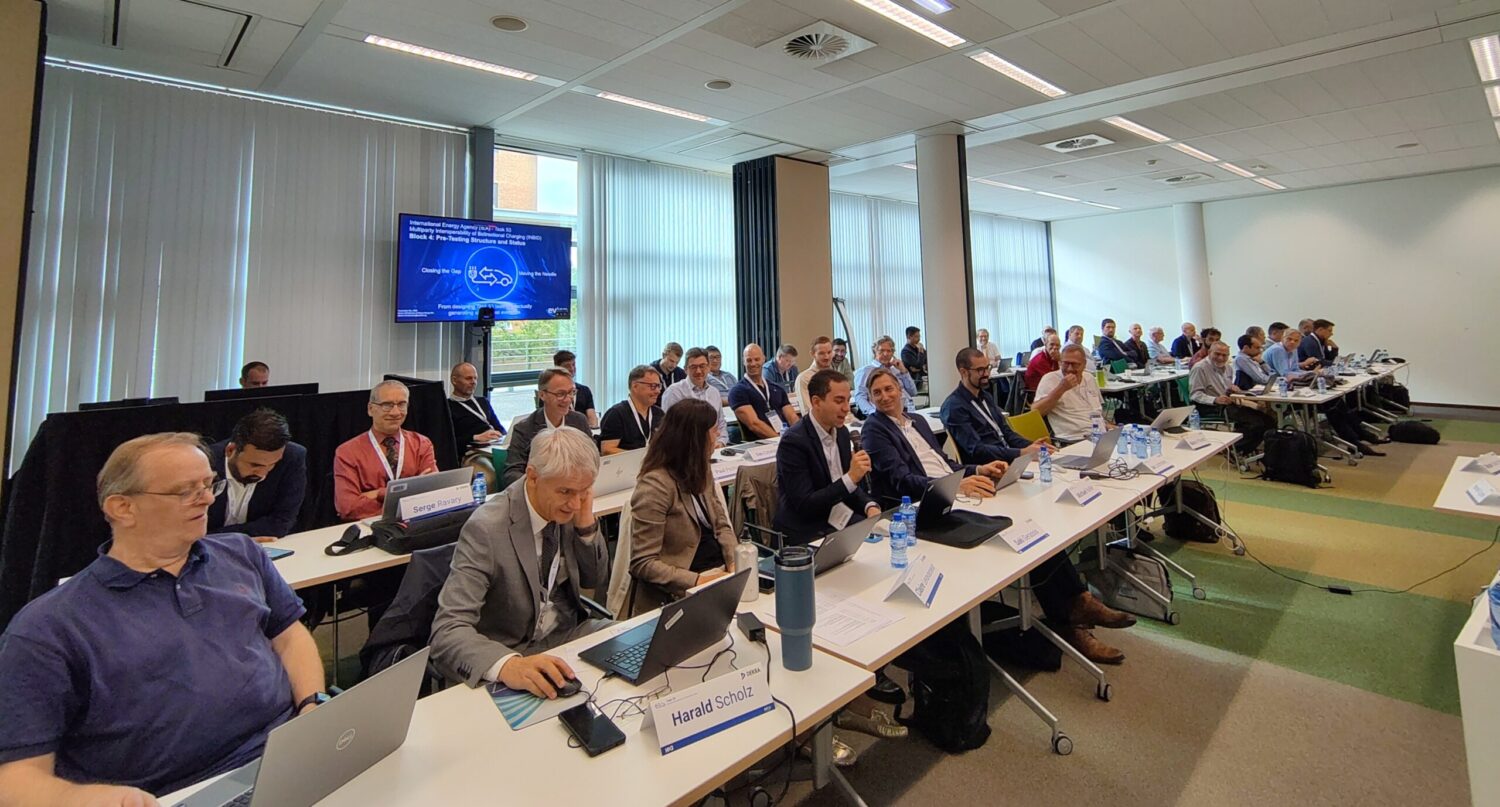
Partners voted both online and in person, with one vote per participating company and one vote per country delegate. The Task 53 core team did not vote.
By reaching consent on 11 voting topics, Partners approved the first four chapters of the Operational Handbook (Chapter 1: Metholdology, Chapter 2: Purpose Scope, Audience and Confidentiallity, Chapter 3: Key Terminology, Chapter 4: Relevant Regulations and Standards) the creation of an ISO 15118-20 subset and implementation guide including Amendment 1 for AC, and a two-phase testing architecture. They also approved a continuous improvement process, linking successive testing rounds to updates of the guidance.
We also approved the approach of prioritizing of the relevant functions and creation of these instructions with reference to EN 50549 and consideration of RfG 2.0, Data & Governance Document, NDA, new Guiding Principles. |